Restless
Gus Van Sant is a director who can skilfully create films that appeal to both mainstream and independent cinema lovers. His talents are never in question as he has shown on numerous occasions that he is one the most interesting directors working today. However, this does not mean that he is immune from minor missteps here and there. Take his latest film Restless for example, at first glance it seems like it is a film that Van Sant would knock out the park as it features themes of youth, angst, and love. These are themes that he has maximized to wonderful heights in previous films. Sadly though, Restless somehow manages to miss the mark.
The film centres around two teens, Enoch (Henry Hopper) and Annabel (Mia Wasikowska), who strike up a relationship after meeting at a funeral. Enoch has been kicked out of school and spends his time crashing funerals and making chalk outlines of himself. Beside his aunt (Jane Adams), who he does not get along with, the only other thing in Enoch’s life is Hiroshi (Ryo Kase), the ghost of a Japanese kamikaze pilot. Moody as a result of events that took place in the past, Enoch does not let himself get emotionally attached to anyone. This all changes when he meets the pixieish Annabel. She not only accepts him for who he is, quirky ways and all, but also teaches him how to revel in the living as much as he does the dead. Just as Enoch begins to see future possibilities with Annabel, she reveals to him a secret that will drastically affect the couple’s relationship.
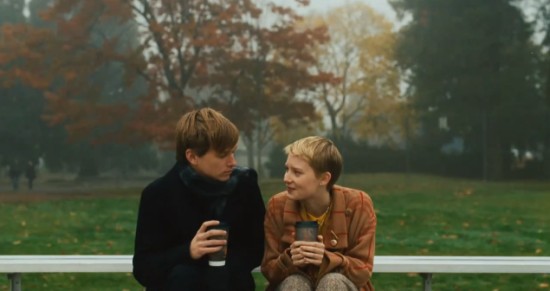
Restless is a film that often feels like two separate films struggling to co-exist. One obvious comparison for the film is Harold and Maude as it has all the quirkiness of that film right down to its moody young protagonist. The second film that Restless feels like at times is Sweet November. As a result there is an unevenness to the whole production that is directly related to the often cliché script. The plot arcs are just too obvious, even the up and down moments of Enoch and Annabel’s relationship feel like a paint-by-numbers production. The character of Enoch in particular becomes rather grating as the film progress. Many of his reveals do not deliver any impact because you know exactly what was coming. More often than not, you are wishing the various reveals would arrive sooner so that the film can get back to focusing on the elements that actually work well...mainly the performances.
Although I enjoyed Wasikowska’s work in The Kids Are All Right, and to a lesser extend Alice in Wonderland, this is the first film that truly made me believe all the hype surrounding her acting abilities. Wasikowska lights up the screen in every scene she is in and helps to keep you interested until the very end. Ryo Kase also delivers a strong performance as Hiroshi, a character that will most likely divide audiences. While it can be argued that there really is no need for Hiroshi in the film, he does offer another layer to Restless that I quite enjoyed. Enoch, despite Hopper’s decent performance, is just not that interesting a character to carry the film on his own. Hiroshi picks up the slack whenever Annabel is not on screen.
Restless is not an awful film by any means, it is just not one that you will remember in a few weeks. The film has several genuinely enjoyable moments, but is bogged down by its formulaic script. In ranking Gus Van Sant’s canon of films, Restless will probably get slotted somewhere in the middle for most cinephiles. It is an average film that never reaches its full potential.
Showing posts with label Mia Wasikowska. Show all posts
Saturday, September 10, 2011
Monday, February 14, 2011
Movie Marketing Monday
X-Men: First Class
X2 was the only film that I actually like in this franchise. The one thing that has my interest about this reboot is the casting of James McAvoy as Professor Xavier and Michael Fassbender as Magneto.
Jane Eyre
Fassbender pops up again in this star-studded film. While I enjoy the Jane Eyre story, I wonder if there will ever be a big screen remake of Wide Sargasso Sea?
Labels:
Cary Fukunga,
James McAvoy,
Jamie Bell,
Jane Eyre,
Jennifer Lawrence,
Judi Dench,
Kevin Bacon,
Matthew Vaughn,
Mia Wasikowska,
Michael Fassbender,
Movie Marketing Monday,
Sally Hawkins,
X-Men
Tuesday, November 30, 2010
The Kids Are All Right So Stop Asking
The Kids Are All Right
As a newlywed the one question I always get is “so how is married life treating you?” To which I usually respond “good so far, just taking it one day at a time.” The latter part of my response always seems to evoke a peculiar look from the person who initially asked the question. I guess they expect me to be wearing the same rose colour glasses that many wear just after the “big day”. Yet that has never been my style, I have always taken a more realistic approach to relationships. I am fully aware that relationships take a lot to maintain and it only gets harder as the years go by.
It is this understanding that makes Lisa Cholodenko’s film, The Kids Are All Right, flow so well. Nic (Annette Benning) and Jules (Julianne Moore) have been in a committed relationship for 18 years. Living with their two teenage children, Joni (Mia Wasikowska) Laser (Josh Hutcherson), the couple appear to have the perfect life. The cracks in their relationships only begin to surface when their kids decide to seek out their biological father, Paul (Mark Ruffalo). The presence of Paul comes as a huge shock to Nic and Jules, and forces them to re-evaluate the dynamics of their relationship.
The Kids Are All Right examines how easily people fall into particular roles in relationships. These roles often become a prison of sorts as they inadvertently serve as the thing that defines them most in their relationships. Nic has always been the assertive one in the union. She is the bread winner who strives for excellence. These traits have been passed down to Joni, who Nic gave birth to. Jules on the other hand is the free spirit who never follows through with things. Her passions are often fleeting which makes it hard to for Nic to truly get behind Jules’ latest plan to start a landscaping business.
In many ways, Paul represents the sides of Nic and Jules that they have lost during their lengthy relationship. Paul has managed to turn his lack of formal education into a successful restaurant business, while still maintaining that passion for the finer things in life. In Paul’s case this includes music, wine and women. This is why Nic and Jules find themselves in such a tailspin around Paul. Jules sees everything she fell in love with about Nic in Paul. Paul also serves as a reminder to Nic of what her life was before everything became so serious.
Although there are several levels at play, Cholodenko’s film is able to express them all well through her wonderfully written script. While Benning, Moore, and Ruffalo will receive praise for their great performances, and rightfully so, it is the screenplay that makes this film a must-see in my opinion. Similar to her work in both High Art and Laural Canyon, Lisa Cholodenko has a way with words that is not appreciated the way it should be. There is rarely a moment where the plot or the situation feels forced. There are many moments in The Kids Are All Right where you can identify with the elements of their relationships. The excellent script coupled with the great performances allows The Kids Are All Right to standout above other recent films that have tried to show just how complicated relationships really are.
As a newlywed the one question I always get is “so how is married life treating you?” To which I usually respond “good so far, just taking it one day at a time.” The latter part of my response always seems to evoke a peculiar look from the person who initially asked the question. I guess they expect me to be wearing the same rose colour glasses that many wear just after the “big day”. Yet that has never been my style, I have always taken a more realistic approach to relationships. I am fully aware that relationships take a lot to maintain and it only gets harder as the years go by.
It is this understanding that makes Lisa Cholodenko’s film, The Kids Are All Right, flow so well. Nic (Annette Benning) and Jules (Julianne Moore) have been in a committed relationship for 18 years. Living with their two teenage children, Joni (Mia Wasikowska) Laser (Josh Hutcherson), the couple appear to have the perfect life. The cracks in their relationships only begin to surface when their kids decide to seek out their biological father, Paul (Mark Ruffalo). The presence of Paul comes as a huge shock to Nic and Jules, and forces them to re-evaluate the dynamics of their relationship.
The Kids Are All Right examines how easily people fall into particular roles in relationships. These roles often become a prison of sorts as they inadvertently serve as the thing that defines them most in their relationships. Nic has always been the assertive one in the union. She is the bread winner who strives for excellence. These traits have been passed down to Joni, who Nic gave birth to. Jules on the other hand is the free spirit who never follows through with things. Her passions are often fleeting which makes it hard to for Nic to truly get behind Jules’ latest plan to start a landscaping business.
In many ways, Paul represents the sides of Nic and Jules that they have lost during their lengthy relationship. Paul has managed to turn his lack of formal education into a successful restaurant business, while still maintaining that passion for the finer things in life. In Paul’s case this includes music, wine and women. This is why Nic and Jules find themselves in such a tailspin around Paul. Jules sees everything she fell in love with about Nic in Paul. Paul also serves as a reminder to Nic of what her life was before everything became so serious.
Although there are several levels at play, Cholodenko’s film is able to express them all well through her wonderfully written script. While Benning, Moore, and Ruffalo will receive praise for their great performances, and rightfully so, it is the screenplay that makes this film a must-see in my opinion. Similar to her work in both High Art and Laural Canyon, Lisa Cholodenko has a way with words that is not appreciated the way it should be. There is rarely a moment where the plot or the situation feels forced. There are many moments in The Kids Are All Right where you can identify with the elements of their relationships. The excellent script coupled with the great performances allows The Kids Are All Right to standout above other recent films that have tried to show just how complicated relationships really are.
Tuesday, March 23, 2010
Alice's Land Left Me Wondering
Alice in Wonderland
Tim Burton is known for his surreal visuals and this film is no different. Alice in Wonderland’s greatest strength is the wonderful art direction and special effects. This is probably Burton's best looking film in years; even the minor details, such as the White Queen's soldiers having the heads of chess pieces, are a treat. If you exclude Stayne (Crispen Glover), who looks awkward in every scene he is in, it is tough to find fault with the outstanding visuals. The funny thing is, for a film that had such wonderful art direction, the 3D aspects were shockingly poor. I will not get on my usual soapbox about how 3D is a cash grab, as I have beating that horse to death. Regardless, I can easily see visual elements, like the seamless incorporation of the Cheshire Cat in many scenes, amazing audiences in either format.
Speaking of the Cheshire Cat, I thought Stephen Fry's voiceover work was near perfect. The same can also be said for Alan Rickman, who brings the Abosolom to life with a mystic charm. The interesting thing about Fry and Rickman's performances is how easily they steal scenes from the actors on screen. You know you have problems when the CGI characters are far more interesting than the human ones. Which brings me to one of the flaws with Alice in Wonderland; the film has too much talent and not enough use for them.
It is rare that you walk into a film starring Johnny Depp and walk away being more wowed by the supporting characters, like the aforementioned Fry and Rickman, yet that is exactly what happens here. While I liked the darker tone that Depp gave the Mad Hatter, his overall performance was surprisingly dull. I understand that Depp is trying to find a balance between exploring the root of Hatter’s madness and being the comic relief; but he often falls short on both parts. At times it felt like Johnny Depp was merely channeling the Scottish cousin of his Willy Wonka character from Charlie and the Chocolate Factory. The difference being that the Mad Hatter’s often mumbles large chunks of his dialogue. At first I thought I was merely burned out by the Depp/Burton pairing as this is the fourth straight film they have done together, and eighth film in total. Then I realized that even the new players to Tim Burton's world were not fairing much better.
Mia Wasikowska is a serviceable but ultimately forgettable Alice. Even when she final raises up and embraces her female independence, which the entire film is building towards, it does not carry the weight it should. We should be cheering Alice along her journey yet I found myself caring less about what happened to her as the film went along. I will say that Wasikowska was much better than Anne Hathaway, as she at least had things to do. Anne Hathaway, on the other hand, had to suffer through a painfully awkward performance as the White Queen. Hathaway serves no real purpose in the film other than to be the embodiment of good. Since the White Queen has sworn not to hurt a living thing, she is merely glides around all day with her dainty hands in the air. It is shame to see such a talented actress like Hathaway take on such a meaningless role.
The only on screen actor that really seems to fit the tone of the film is Helena Bonham Carter. As the Red Queen, Carter is a delight to watch in her small role. In a few short scenes she conveys a queen who is both ruthless and desperately in need of acceptance. If you take away Helena’s performance there is no other human character that really generates any interest. Alice’s family and friends are mere footnotes to the overall picture.
While the art direction, and a few key performances, keeps Alice in Wonderland afloat; the film, in the end, is much ado about nothing. Tim Burton’s version of the source material creates a beautiful but hollow world, which is probably why Alice found it so forgettable in the first place.
Based on Lewis Carroll's two stories, Alice's Adventures in Wonderland and Through the Looking Glass, as well as his poem "Jabberwocky", Tim Burton's latest film, Alice in Wonderland, is not short on source material...although it often feels that way at times. In this latest version of the classic story, Alice (Mia Wasikowska) is 19 years-old who is tormented by the same recurring nightmare, of a strange land, since she was young girl. On the same day Alice receives a marriage proposal, from a man whom Alice does not love, she sees a strangely dress White Rabbit (Martin Sheen) scampering around in the garden. While chasing the rabbit Alice stumbles into a hole that transports her to the magical Wonderland. Alice has no recollection of the place, which she first visited when she was a child, and thinks it is all a dream. Yet the inhabitants of Wonderland, including the Mad Hatter (Johnny Depp), desperately need Alice to regain her memory. It has been foretold that Alice will dethrone the ruthless Red Queen (Helena Bonham Carter) by defeating the beast known as the Jabberwocky (Christopher Lee). Once the Jabberwocky is destroyed, the White Queen (Anne Hathaway) can resume her rightful place as the true ruler of Wonderland.
Tim Burton is known for his surreal visuals and this film is no different. Alice in Wonderland’s greatest strength is the wonderful art direction and special effects. This is probably Burton's best looking film in years; even the minor details, such as the White Queen's soldiers having the heads of chess pieces, are a treat. If you exclude Stayne (Crispen Glover), who looks awkward in every scene he is in, it is tough to find fault with the outstanding visuals. The funny thing is, for a film that had such wonderful art direction, the 3D aspects were shockingly poor. I will not get on my usual soapbox about how 3D is a cash grab, as I have beating that horse to death. Regardless, I can easily see visual elements, like the seamless incorporation of the Cheshire Cat in many scenes, amazing audiences in either format.
Speaking of the Cheshire Cat, I thought Stephen Fry's voiceover work was near perfect. The same can also be said for Alan Rickman, who brings the Abosolom to life with a mystic charm. The interesting thing about Fry and Rickman's performances is how easily they steal scenes from the actors on screen. You know you have problems when the CGI characters are far more interesting than the human ones. Which brings me to one of the flaws with Alice in Wonderland; the film has too much talent and not enough use for them.
It is rare that you walk into a film starring Johnny Depp and walk away being more wowed by the supporting characters, like the aforementioned Fry and Rickman, yet that is exactly what happens here. While I liked the darker tone that Depp gave the Mad Hatter, his overall performance was surprisingly dull. I understand that Depp is trying to find a balance between exploring the root of Hatter’s madness and being the comic relief; but he often falls short on both parts. At times it felt like Johnny Depp was merely channeling the Scottish cousin of his Willy Wonka character from Charlie and the Chocolate Factory. The difference being that the Mad Hatter’s often mumbles large chunks of his dialogue. At first I thought I was merely burned out by the Depp/Burton pairing as this is the fourth straight film they have done together, and eighth film in total. Then I realized that even the new players to Tim Burton's world were not fairing much better.
Mia Wasikowska is a serviceable but ultimately forgettable Alice. Even when she final raises up and embraces her female independence, which the entire film is building towards, it does not carry the weight it should. We should be cheering Alice along her journey yet I found myself caring less about what happened to her as the film went along. I will say that Wasikowska was much better than Anne Hathaway, as she at least had things to do. Anne Hathaway, on the other hand, had to suffer through a painfully awkward performance as the White Queen. Hathaway serves no real purpose in the film other than to be the embodiment of good. Since the White Queen has sworn not to hurt a living thing, she is merely glides around all day with her dainty hands in the air. It is shame to see such a talented actress like Hathaway take on such a meaningless role.
The only on screen actor that really seems to fit the tone of the film is Helena Bonham Carter. As the Red Queen, Carter is a delight to watch in her small role. In a few short scenes she conveys a queen who is both ruthless and desperately in need of acceptance. If you take away Helena’s performance there is no other human character that really generates any interest. Alice’s family and friends are mere footnotes to the overall picture.
While the art direction, and a few key performances, keeps Alice in Wonderland afloat; the film, in the end, is much ado about nothing. Tim Burton’s version of the source material creates a beautiful but hollow world, which is probably why Alice found it so forgettable in the first place.
Subscribe to:
Posts (Atom)


