Showing posts with label Gus Van Sant. Show all posts

Saturday, September 10, 2011

TIFF Review: Restless

Restless

Gus Van Sant is a director who can skilfully create films that appeal to both mainstream and independent cinema lovers. His talents are never in question as he has shown on numerous occasions that he is one the most interesting directors working today. However, this does not mean that he is immune from minor missteps here and there. Take his latest film Restless for example, at first glance it seems like it is a film that Van Sant would knock out the park as it features themes of youth, angst, and love. These are themes that he has maximized to wonderful heights in previous films. Sadly though, Restless somehow manages to miss the mark.

The film centres around two teens, Enoch (Henry Hopper) and Annabel (Mia Wasikowska), who strike up a relationship after meeting at a funeral. Enoch has been kicked out of school and spends his time crashing funerals and making chalk outlines of himself. Beside his aunt (Jane Adams), who he does not get along with, the only other thing in Enoch’s life is Hiroshi (Ryo Kase), the ghost of a Japanese kamikaze pilot. Moody as a result of events that took place in the past, Enoch does not let himself get emotionally attached to anyone. This all changes when he meets the pixieish Annabel. She not only accepts him for who he is, quirky ways and all, but also teaches him how to revel in the living as much as he does the dead. Just as Enoch begins to see future possibilities with Annabel, she reveals to him a secret that will drastically affect the couple’s relationship.
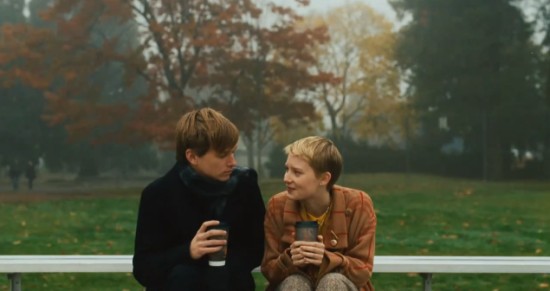

Restless is a film that often feels like two separate films struggling to co-exist. One obvious comparison for the film is Harold and Maude as it has all the quirkiness of that film right down to its moody young protagonist. The second film that Restless feels like at times is Sweet November. As a result there is an unevenness to the whole production that is directly related to the often cliché script. The plot arcs are just too obvious, even the up and down moments of Enoch and Annabel’s relationship feel like a paint-by-numbers production. The character of Enoch in particular becomes rather grating as the film progress. Many of his reveals do not deliver any impact because you know exactly what was coming. More often than not, you are wishing the various reveals would arrive sooner so that the film can get back to focusing on the elements that actually work well...mainly the performances.

Although I enjoyed Wasikowska’s work in The Kids Are All Right, and to a lesser extend Alice in Wonderland, this is the first film that truly made me believe all the hype surrounding her acting abilities. Wasikowska lights up the screen in every scene she is in and helps to keep you interested until the very end. Ryo Kase also delivers a strong performance as Hiroshi, a character that will most likely divide audiences. While it can be argued that there really is no need for Hiroshi in the film, he does offer another layer to Restless that I quite enjoyed. Enoch, despite Hopper’s decent performance, is just not that interesting a character to carry the film on his own. Hiroshi picks up the slack whenever Annabel is not on screen.

Restless is not an awful film by any means, it is just not one that you will remember in a few weeks. The film has several genuinely enjoyable moments, but is bogged down by its formulaic script. In ranking Gus Van Sant’s canon of films, Restless will probably get slotted somewhere in the middle for most cinephiles. It is an average film that never reaches its full potential.

Wednesday, September 1, 2010

Countdown to TIFF: 2003 in Review

TIFF 2003


I learned a valuable lesson at the 2003 Toronto International Film Festival, in the end, everything about TIFF is based on luck. No matter how much research you do, you never truly know what you are going to get until you are in the theatre and the film is actually playing. I learned this as I sat through, what seemed like, all the bad French films that played that year. This is not to say that there were not several good French films available; it just happened that I somehow manage to pick everything but the good ones. 2003 was the weakest year for me in regards to the ratio of good films to bad ones that I watched.

Total Number of Films Watched: 31

My Top 5:

Dogville
Lost In Translation
The Station Agent
A Good Lawyer’s Wife
Elephant

Honourable Mention: 21 Grams, Sexual Dependency, November, Casa de los Babys, Code 46, The Time of the Wolf, Save the Green Planet, The Boys from County Claire

The Disappointments: In the Cut, Twentynine Palms, A Problem With Fear, Errance, Wonderland, Raja, Who Killed Bambi?


The Whale Riders (a.k.a. I regret passing on these films): The Barbarian Invasion, Zatoichi, The Fog of War, Bus 174, Shattered Glass, Good Bye, Lenin!, Coffee & Cigarettes, Les Triplettes de Belleville, Matchstick Men.

Memorable Moment: Getting to see both Dogville and Lost In Translation as they were high on my “must see” list.

Random Star Sightings: Gus Van Sant, Woody Harrelson, Jane Campion, John Sayles, Darryl Hannah, Marcia Gay Harden, Lili Taylor, Thomas Jane, Sang-Soo Im

Tuesday, January 19, 2010

Polytechnique Exams A Killer

Polytechnique

There is often debate over what real-life events should and should not be covered on film. Regardless of whether the subject is war, genocide, rape, or murder, the fact that it is based on actual events takes away from the escapist element of cinema. This is why films, such as Denis Villeneuve’s Polytechnique, often face a slew of harsh criticisms even before they are released. While some may feel that making a film based on real-life tragedy is insensitive to the victims and their families who lived through it; if done right, these films can serve as a reminder of how important it is to never forget what mankind is capable of.

Polytechnique is a dramatization of the 1989 Montreal Massacre where Marc Lépine (Maxim Gaudette) killed 14 female engineering students, and wounded 14 other people (including 4 men), at the Polytechnic School of Montreal. The narrative of the films follows three individuals on that deadly day and the impact the massacre had on their lives. After the startling opening, we are introduced to Lépine as he is prepping his semi-automatic weapon and preparing his suicide note. Lépine’s note reveals his deep hatred of the feminist movement and how he felt women were destroying man’s role in society. The second person of note in the film is Valerie (Karine Vanasse), an engineering student who is struggling to overcome the confines that come with being a woman in a male dominated profession. Lastly we meet Jean-François (Sébastine Huberdeau), an engineering student who initially thinks that getting a grasp on the course material would be the hardest thing he would have to deal with on this day.

The film is sparse on dialogue but extremely powerful. Director Denis Villeneuve provides just enough dialogue to make his characters rounded enough for us to care about. All it takes is a few well chosen scenes to give us all we need to know about Valerie and Jean-François. The killer never really utters a single word in the film. All of his dialogue comes courtesy of the “voiceovers” when he is writing his suicide notes. Villeneuve skillfully uses other avenues, such as a class presentation on entropy, to provide a better understanding of Léger’s unstable nature.

While the actors do a terrific job in the film, it is Villeneuve who deserves the most praise. His previous films, 32nd Day of August on Earth and Maelstrom, one of my all-time favourite Canadian films, already proved that Denis Villeneuve was a talented director. Yet Villeneuve has truly outdone himself with Polytechnique. The film is both startling and beautiful all at the same time. Villeneuve’s film, similar to another stellar 2009 film, Hunger, is artistic without sensationalizing the horrific event.

I am sure many will see similarities in tone to Gus Van Sant’s Elephant, which I saw at TIFF. a few years back, but I think Polytechnique far surpasses that film. Villeneuve’s film, similar to the Montreal Massacre itself, will stay in our conscious for many years to come. Polytechnique is easily one of the best films of 2009.