Showing posts with label Michael Mann. Show all posts

Sunday, September 18, 2011

Drive One Thrilling Commute

Drive

The rumbling started early in the theatre, at first it was just a few snide comments here and there. By the time the credits started to role the crumbling had reached its crescendo when one viewer yelled out “this is one of the worst movies I have ever seen.” While each person is entitled to their own opinion, it was clear that the majority of the audience was anticipating a completely different film than what they got. The marketing campaign is trying to sell Drive as a film that is in the same vein as The Transporter series, when in fact it is a far slicker film noir that does not mainly rely on “fist of fury” to advance the plot.

Ryan Gosling continues his string of stirring performances as an unnamed man, referred to as “Driver”, who has an unbelievable talent when it comes to cars. Working as both a mechanic and a part-time film stunt-driver, Driver tends to keep to himself. He barely talks to his boss Shannon (Bryan Cranston). This all changes when Driver meets and falls for his next door neighbour Irene (Carey Mulligan), a single mother whose husband Standard (Oscar Isaac) is unexpectedly released from prison early. Standard owes money to some men who are threatening to harm Irene and his son Benicio (Kaden Leos), if he does not agree to rob a pawn shop. Fearing for Irene and Benicio’s safety, Driver volunteers to be Standard’s getaway driver. What Driver does not know is that the money they are about to steal belongs to local gangsters Bernie (Albert Brooks) and Nino (Ron Perlman).

Drive is very reminiscent of the action thrillers that the likes of Michael Mann and Brian De Palma use to make in the 80’s. Nicolas Winding Refn infuses the picture with his unique style which allows the film to separate itself from contemporary action films. One thing audiences will notice immediately is how little dialogue is spoken by the protagonist. While Albert Brooks and Ron Perlman play their scenes large, Gosling is always internalizing his emotions. There are numerous scenes in which Refn lets the camera quietly linger on Driver’s face as the character works things out. Having an action film that is filled with more quite moments than heart stopping action is almost unheard of in an age where action films are usually filled with loud explosions.


This is not to say that Drive is devoid of action, in fact the film has several great action scenes. The major difference here is that scenes of violence flourish as a result of the silence that often precedes it. Like most of Refn’s films the violence is brutal and unflinching, but never reaches the point of being gratuitous. Refn also keeps the action leaning towards the more realistic side of things. There is no scene where Driver is in a shootout with eight guys at once, nor is there a scene where Driver is jumping out of a building just before it explodes. The final action sequence may seem underwhelming to those expecting a standard action film ending, yet in the context of the world that Refn has created, the sequence works extremely well.

Refn is meticulous with how he orchestrates both his action scenes as well as his quieter moments. In one tense elevator scene, Driver slowly moves the unaware Irene behind him for safety. The use of lighting in this scene is brilliant. Refn first darkens the elevator to accentuate the pending violence, but then brightens the light on Irene to symbolize her character’s awakening. In the span of a few minutes Irene shares a romantic moment with Driver and also realizes his tendency towards violence. It is moments like these that make Drive such a thrill to watch.

Friday, August 19, 2011

Heist Week: Thief Breaks Into a Familiar Routine

Thief

It is interesting to look back on a director’s first cinematic offering when you have followed their career over the years. While I have been a fan of Michael Mann’s work since his days on Miami Vice, the television show not the movie, somehow his big screen debut, Thief, slipped by me.

Based on the novel The Home Invaders, Thief follows an expert jewel thief who finds himself in a tough situation when he agrees to do a one-time jewelry heist for a Chicago mob boss, Leo (Robert Prosky). An ex-convict, Frank (James Caan) finally seems to have everything going his way. By day he owns both a car dealership and a bar, and by night he steals high end jewelry from the toughest safes in town with the help of his friend Barry (James Belushi). However the one thing that is missing from Frank’s life is a family, which he hopes to start with Jessie (Tuesday Weld). Unfortunately Leo has other plans for Frank and sees their one-time partnership more as a life time arrangement.

If you have encountered any of Michael Mann’s other crime films than you know what to expect from Thief. While interesting at times, it often feels like a paint-by-numbers production. The film follows several genre clichés including the corrupt cops looking to extort Frank and the one last job scenario. Being a Mann film, Thief does have some nice tension sprinkled throughout. In one particular theme Mann draws out a sequence where Frank is returning to his car dealership unaware he his about to be ambushed by Leo’s men. The scene really does keep the audience on the edge as there are several outcomes that can occur in those few moments.


It was also nice to see that the big heist is not shown in detail. Mann displays how Frank conducts his robberies at the very beginning of the film but never goes into that level of detail during the main heist he commits for Leo. In many ways the heist Leo orchestrates is not really important at all. The film is more about the honor, or lack there of, amongst thieves. Frank sees himself as a man with nothing to lose, yet Leo is quick to point out that his family responsibilities no longer allow him to have that prison mentality.

The back and forth between Frank and Leo is great, however not enough of it is featured in the film. More moments like that would have helped to elevate the film. What really hurts the film are the elements that do not directly relate to Frank’s burglaries, mainly his relationship with Jessie. The love arc between Frank and Jessie feels rushed and unfocused. The film would have been better served had Jessie’s character been developed further.

The saving grace for this film is the performances. Caan is enjoyable as he carries that same level of swagger that he had in The Godfather. Frank comes off a little too invincible for my liking in the last twenty minutes, but that has more to do with Mann’s script rather than Caan’s performance. It should also be noted that both James Belushi and Willie Nelson give pleasantly surprising performances in their supporting roles. In the end, despite some tense moments, Thief is not a film that will leave a lasting impression. It recycles themes that have already been covered far better in other films of this genre.

Thursday, June 2, 2011

Which is Better?


Brian De Palma
10 sample films:

Scarface
Blow Out
The Untouchables
Carrie
Snake Eyes
Dressed to Kill
Mission: Impossible
Carlito’s Way
Body Double
Femme Fatale

or


Michael Mann
10 sample films:

Heat
The Insider
Manhunter
Collateral
The Last of the Mohicans
Ali
The Keep
Public Enemies
Thief
Miami Vice

Which do you prefer? Let me know in the comments section

Wednesday, December 15, 2010

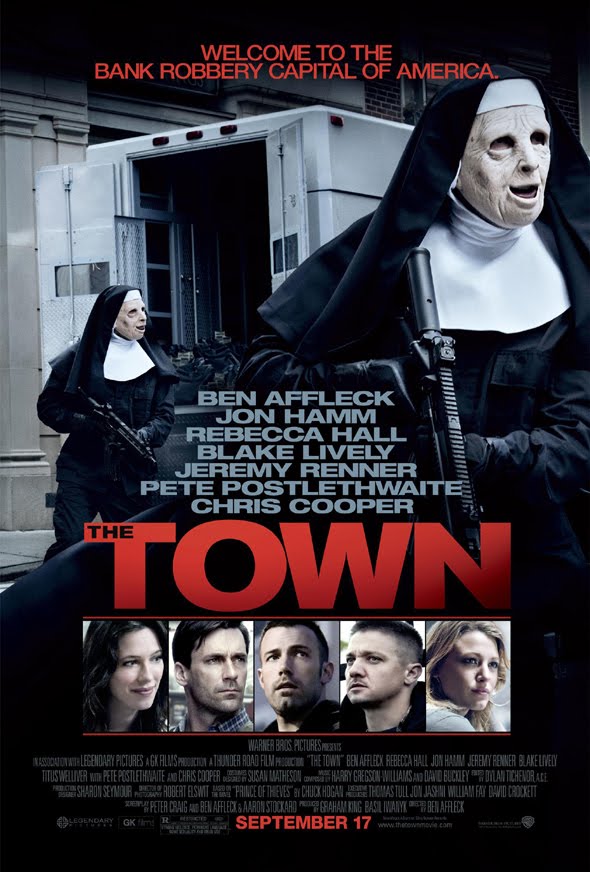
The Town is Like Any Other Town

The Town

Can anyone name a member of the National Board of Review? Who are they? And why do so many film lovers, myself included, go into hysterics once they release their annual best of the year list? Despite not knowing who actually comprises the NBR, their annual best of list marks the official start of the three month long award season. Though I normally agree with their selections, there have been times when the NBR has unjustly raised my hopes for a film. Such was the case with the cops and robbers caper, The Town. As The Town made NBR’s top ten list this year, I was expecting the film to have something truly magical. That special moment which made The Town standout above the other 250 films that the NBR screened this year. Instead, The Town ended up being a standard crime film with a few well shot action sequences.

Set in the Charlestown section of Boston, notoriously known for the high percentage of criminals it produces, The Town follows a group of friends as they try to elude the FBI while going after one final score. Ring leader Doug MacRay (Ben Affleck) is starting to tire of the criminal lifestyle. Although good at what he does, he knows that if he stays in Charlestown he will end up behind bars like his father, Stephen (Chris Cooper). Doug envisions a better life for himself after meeting Claire (Rebecca Hall), who happens to be the manager of a bank MacRay’s team has robbed. While Doug longs for a life outside of Charlestown, his best friend James (Jeremy Renner) wants the team to continue their streak of bank robberies. With FBI Agent Frawley (John Hamm) closing in on the gang, Doug must decide where is loyalties truly lie.

The Town is a decent, if not predictable, crime movie. What makes the film work for the most part are the performances from the cast. Not to mention the skilled direction of Ben Affleck. Affleck proved with his directorial debut, and vastly superior film, Gone Baby Gone, that he knows how to get strong performances out of his cast. I especially enjoyed the work of Pete Postlethwaite and Chris Cooper in their very brief cameos. I also like how Affleck orchestrates his action sequences. The heist scenes, particularly the one that evolves into a brilliant car chase scene with the gang evading the cops in a minivan. These are easily the most tenses moments in the entire film.


So why did this film not “wow” me the way it did the NBR? I just could not get past its predictability. Not to mention that The Town has too many loose ends which are never fully realized. The two most interesting aspects of the story are Doug’s relationship with his father, and the father’s past with Fergus (Postlethwaite). Unfortunately we only get a small snippet of the father/son arc. The audience must rely on Fergus to shed further light into Stephen’s defeated state. Yet Fergus is introduced far too late in the picture. The Town spends so much time building up both the love story and the Doug/Agent Frawley angle that the sudden appearance of Fergus towards the end seems rather out of place. Either introduce Fergus sooner, and cut down on the pointless Krista (Blake Lively) plotline, or leave both him and Stephan out of the picture completely.

As heist films go, The Town is enjoyable as it often feels like a lighter version of Michael Mann’s Heat. The film works best if you temper your expectations. If you go in expecting anything more you will be greatly disappointed. Many are calling The Town one of the year’s best films, but it is ultimately nothing more than a competent crime film that may keep you entertained for a few hours. 


Sunday, December 6, 2009

Enemies Make Feud Public

Public Enemies

The story of Robin Hood has always been appealing on tale. The idea of someone taking from the wealthy and giving to the poor does have a nice ring to it, especially in this current economy. Yet is it way he swoops in and steals the money? Or is Robin Hood himself that makes the tale interesting? These questions crossed my mind while watching Michael Mann's Public Enemies.

Set during the fourth year of the Great Depression, crime is on the rise and notorious bank robber John Dillinger (Johnny Depp) is making a mockery of the law. Fed up with Dillinger's antics, the Director of the FBI, J. Edgar Hoover (Billy Crudup), assigns agent Melvin Purvis (Christian Bale) to lead a task force to bring John Dillinger to justice once and for all. Purvis soon realizes that capturing Dillinger will be much harder than both he and Hoover had ever expected it to be. Dillinger shows no signs of slowing down nor does he have any weaknesses. Of course this may all change after he meets the Billie Frechette (Marion Cotillard).

Though he kept everything he stole Dillinger was still viewed as the Robin Hood of his time. Dillinger became a symbol for those suffering through the Great Depression . Yet the Depression merely serves as a backdrop for the film as Mann is more interested in the various ways Dillinger robbed banks and broke of jail. While these moments were very entertaining to watch, by time the film ended, I could not help but wonder how much did I actually learn about any of the parties involved? Clearly John Dillinger was a charismatic criminal who had the intelligence needed to get away with what he did. Yet after the jail break scene, and the scene were the cops pass him in the car, you have to question whether Dillinger truly was a genius? Or were the cops just really dumb?

Since Mann opts not to delve too deep into his characters we only get glimpses of what makes the characters tick. This is most evident when you look at Bale's Melvin Purvis, who really gets short changed in this picture. Purvis is clearly way over his head when he is promoted but we rarely see how the pursuit affects him emotionally. This ultimately diminishes the impact of what happens to him at the end of the film. Also, Mann does not provide Bale room to truly showcase his range. Purvis is a rather one-note character throughout the entire film. Despite Purvis' many errors and his inner turmoil, Mann portrays him mainly as the hard stoic agent. Bale would have been much more interesting in the film had he been able to show more of the cracks within Purvis' wall.

Aside the limitations set on Bale , the majority of the cast does a decent job of breathing life into their characters. Depp and Cotillard are the standouts in the picture as there scenes together offer a nice break from the standard cops and robber stuff. Despite the lack of depth, Mann does create a film that is, if nothing else, fairly entertaining. All the trademark Mann element's are there: the handheld video shots, the elaborate shootout sequences etc. Although Public Enemies is not as spectacular as I hoped it would be, it was entertaining enough for a mild recommendation.