Showing posts with label Toshirô Mifune. Show all posts

Friday, June 25, 2010

Fricassee Five Friday: Tom Cruise

Spiced Just Right


Magnolia

A guy jumps on a couch once and the people instantly forget that he has the ability to deliver great performances. So for those who think Cruise is all big budget fluff and tabloid fodder let me bring your attention to one of my favourite characters, Frank T.J. MacKey, in my all-time favourite movie. Though Cruise was nominated for an Oscar, for best supporting, he lost out to Michael Caine’s work in The Cider House Rules. Personally I think Cruise’s performance will be the one out of the two that most people will remember in ten years.


Interview with the Vampire

Interview with the Vampire and Collateral provided Cruise the opportunity to play the villain; something he should do more of. While I like Collateral slightly more than this film, Cruise had to overcome much more adversity here. It cannot be easy for an actor when the author of the novel being adapting, in this case Anne Rice, publicly slams you for being cast in the lead role. Luckily Tom got the last laugh as Rice had to eat some humble pie and acknowledge that he was fantastic in the role.


Top Gun

Part of me wanted to include The Firm, or “See Tom Run” as I like to call it, on this list as I really liked that film. Any movie that makes Tom Cruise deathly afraid of the Quaker Oats pitchman, aka Wilford Brimely, deserves the token guilty pleasure spot on the list. Still if I had to choose between The Firm and the pure popcorn fun that is Top Gun, it will be fighter jets all the way. Cocky and arrogant characters fit Tom well, see Jerry Maguire, Collateral, and Magnolia for further examples of this.


The Last Samurai

Yes this film is in the same “white savior” vein of Dances with Wolves, Avatar, and countless other movies of its ilk. Regardless, I really like this film. Many of the movie’s best moments come from the interactions between Ken Wantanabe and Cruise’s character. Tom’s samurai may not have been as cool as Toshirô Mifune’s or Forest Whitaker’s, but he did a good job nonetheless.


Minority Report

The reason films such as A Few Good Men, Rain Man, The Outsiders, and Jerry Maguire did not make the list is due to the fact that Cruise’s supporting casts are the real stars of the show. Chances are your fondest memories of those films are scenes involving NichoIson, Hoffman, Howell, and Gooding Jr. The same thing almost happens in Minority Report as Samantha Morton gives her usual great performance. Though, at the end of the day, it is the pairing of Cruise and Spielberg that keep this film moving a top speed. I still think Minority Report runs twenty minutes too long but otherwise I enjoyed Cruise first real foray into the world of Science Fiction.


Layoff the Cheese


Vanilla Sky

Considering that I am a big fan of the original film, Abre Los Ojos, my views might be a bit biased. Honestly I had no problem with Cruise in this movie. What ruined this picture for me was Cameron Crowe’s need to over explain things instead of letting the audience figure things out for themselves. It was as if Crowe, or maybe the studio, had no faith in the audience’s intelligence.


Far and Away

Reason # 45 why spouses should not work together! I could have easily substituted Days of Thunder in here as I was not fond of that film either. Far and Away was by far the worst of the two films. The interesting thing is Tom Cruise and Nicole Kidman have no on screen chemistry whatsoever. What about Eyes Wide Shut you say? Well the majority of that film is about Cruise’s solo journey. The times they are together on screen, Kidman is the one doing all the heavy lifting.


Mission Impossible II

I literally walked out of the theater at the end of the film unable to remember on significant thing that happened in this movie. MI2 felt like an extremely watered down version of a John Woo film, and that is saying a lot if you consider that Hard Target and Broken Arrow were more entertaining than this film.


Legend

As I commented on another blog’s review of this film, I always think of Ladyhawk whenever someone talks about this film. I think deep down I wish Legend was more Ladyhawk and less…well…Legend. Somewhere Matthew Broderick is pumping his fist victoriously.


War of the Worlds

Remember when I praised the Cruise/Spielberg pairing a few minutes ago…well here is where things get tricky. The first half of this film is actually pretty good. One of my favourite scenes comes when the frantic mob tries to steal Tom’s car not realizing, or caring, that his daughter is still in there. Unfortunately the rest of the film never lives up to the atmosphere that the beginning sets up. I won’t even get into how the Boston elite somehow avoid a world-wide catastrophe!

Thursday, June 24, 2010

Say It Ain’t So Sanjuro


Sanjuro

When the Chamberlain and his family are kidnapped, nine samurai’s from his clan plot to rescue him. Fortunately for the young men, Sanjuro (Toshirô Mifune) just happens to be hanging out in their house (literally) and advises them that a greater scheme is at hand. Sanjuro believes that the Superintendant is responsible for all of this and offers to aide them in their quest to save the Chamberlain. Before Sanjuro and the nine samurai can free the Chamberlain they must figure out how to defeat Hanbei (Tatsuya Nakadai), the samurai in charge of governing the Superintendant’s soldiers

After being wowed by Yojimbo I was hoping for a similar high out of Akira Kurosawa’s follow-up Sanjuro. As any drug addict can attest, chasing that repeat high often leads to more harm than good. After witnessing Yojimbo’s offbeat blend of action and humour I was rather excited to revisit the world of that loveable ronin, Sanjuro. Sadly Sanjuro’s world now suffers from a case of overpopulation. Instead of sitting back and enjoying the wonderful way Sanjuro’s mind works, I was forced to endure several uninteresting supporting characters. At times the movie feels like Sanjuro and the Nine Dwarfs. When the nine other warriors are not whining about wanting to save the Chamberlain, they are constantly disobeying all of Sanjuro’s suggestions. There are only so many times I can watch the same scenes play out.

It is even more infuriating when you consider that Sanjuro has already established himself as “the man” within the first act of the film.I do not know about the rest of you, but if a mysterious ronin appears inside my house and tells me that I have been set up. I might be a bit skeptical at first. Yet if it turns out that he was right about set up, and then proceeds to save my life by taking on twenty to thirty men by himself!!! I would be the first person by his side with a pen and paper in hand ready to take notes.


It also does not help matters that Sanjuro is now dealing with issues of guilt. After an official’s wife comments that Sanjuro is like a shining sword (i.e. always in use) compared to all the best swords which remain in their covering; we see a drastic change in Sanjuro. He begins to feel deep remorse for having to take a person’s life and no longer wants to be viewed as the cool killer. I am all for growth in characters but, for this type of film, the change should fit the essence of the character. It was already established in the first movie that Sanjuro is a caring person whose vanity gets the better of him at times. Did the character really need to go the “why did you make me kill him” route?

It is at this moment where the shine Sanjuro had in Yojimbo slowly begins to dull a bit. It is similar to watching the Star Wars prequels and finding out that the evil Darth Vader, the most fearsome guy in the galaxy, is really just a boy with a broken heart. While I still like the character of Sanjuro on the whole, I wish he had been in a better film than this. Like many sequels, before and after it, Sanjuro does not match its predecessor. While Toshirô Mifune valiantly tries his best to repeat the magic he had in the first film, it is the abundance of useless supporting players that hold his character, and the film, from reaching those heights once again.


Thursday, June 17, 2010

Yo, Jimbo Is One Sly Dude.

Yojimbo

Not too long ago A Life in an Equinox: A Movie Lover’s Journal held an Akira Kurosawa blogathon in honour of the late director’s birthday. Until recently my only experience with Kurosawa has been my VHS copy of Seven Samurai. Akira Kurosawa was always one of those directors who is so well loved that I was never in a rush to see the rest of his works. I figured his films would always be in demand so I would not have any problems find his full canon of work. Recently I decided to pull a few Kurosawa films, Yojimbo and Sanjuro, out of the purgatory that is my long list of “must see films” and finally watch them.

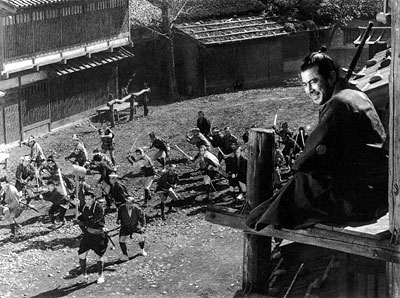
Yojimbo follows the adventures of a wandering samurai, Sanjuro (Toshirô Mifune), who finds himself in the middle of a gang war in a small village. On one side is the gang led by Sebei (Seizaburô Kawazu) who controls the brothel and the silk industry; the other gang is led by Ushitora (Kyû Sazanka) who produces the towns’ sake. Sanjuro, seizing up the situation, sets out to play the gangs off each other by offering his services as a bodyguard to both sides. Sanjuro thinks he has things all figured out but the arrival of pistol-packing Unosuke (Tatsuya Nakadai) will throw a deadly wrinkle into his plans.

The first thing that struck me about Yojimbo was how much humour there was in the film. Early on Akira Kurosawa establishes the fact that both gangs are more bark than actual bite. This not only allows Sanjuro to calculate the situation quickly, but it also provides Kurosawa with an avenue to run wild from a comedic standpoint. Several characters, such as the coffin maker and the official, serve no other purpose than to increase the level of humour even further. There are a few moments when Yojimbo veers dangerously close to bordering on slapstick comedy but Kurosawa always finds a way to reign things back in.


Part of the reason Kurosawa is able to maintain control is due to the wonderful lead character Sanjuro. There is rarely a moment when Sanjuro does not bring a smile to the viewer’s face. There have been many drifters in the history of cinema but few have been as enjoyable as Sanjuro is. Whether he is displaying his swordsmanship, eavesdropping on conversations, or riling up the local restaurant owner, Sanjuro’s charisma is always at the forefront. You can always see the glee in his face when is devilish schemes unfold. What makes Sanjuro a great character is that for all his strengths he still has glaring weaknesses that keep him, and the film, grounded in reality.

I really liked the fact that Kurosawa makes Sanjuro vulnerable on several levels. Despite being a caring individual deep down, Sanjuro is always concerned with maintaining his image as coldhearted killer. When you really look at the character of Sanjuro it becomes apparent that his pride is his greatest weakness. If you really think about it, Sanjuro has no reason to even interfere with the gang battle in the first place. He merely intervenes for the fun of it. Sanjuro loves the fact that he is always the smartest guy in the room. There comes a point in the second act when Sanjuro has too much control over events in the town. Kurosawa shows that Sanjuro is too smart for his own good; and it is his overall arrogance that leads to his abrupt downfall.

It is aspects like these which help Yojimbo to live up to all the acclaim it has received over the years. Thanks to Toshirô Mifune’s great performance as Sanjuro, the film proved to be more enjoyable than I had anticipated it would be. The only thing I have left to ponder is why I took so long to see it?