Showing posts with label Documentary. Show all posts

Thursday, November 18, 2010

One Big Hapa Family A Large Animated Bunch

One Big Hapa Family

The question of identity is one that everyone encounters in some form or another in their lifetime. Depending on your ethnicity, this may be a topic that you have to confront on a daily basis. Even in a multicultural country like Canada, the question of “what are you?” is one that pops up more often than people are willing to admit. The inherent need to associate people with categories is a topic explored in Jeff Chiba Stearns wonderful documentary, One Big Hapa Family.

Jeff Chiba Stearns, the product of an interracial marriage between his Japanese mother and white Canadian father, noticed at a fairly recent family reunion that everyone in his large family was of mixed race. Having had problems answering the question “what are you?” for most of his life, Jeff decided to explore why such a high percentage of Japanese Canadians marry outside of their race.

What starts out as a search to understand his own identity leads to the discovery of some startling facts that date back to the Second World War. Streans looks back to a time when Canada was not so accepting of other cultures as it appears to be now. The war brought out the worst in Canada in regards to racism toward people of Japanese ancestry. It even created a divide between the “hometown Japanese”, who were barely accepted by the communities they lived in for years, and the “coastal Japanese” who were seen as the villains of the war.


Stearns research shows that the need to assimilate with the white Canadians opened up the door to interracial marriages. Part of the appeal had to do with the offspring of these unions, the future generations would look whiter and would not have to deal with the same level of racism that their parents endured. Stearns’ documentary examines how these views have shifted over the years. He also looks at how the younger generations now, more than ever, want to identify with their Japanese roots.

While a well researched and constructed film, the element that really makes this film special is its use of animation. Stearns, an animator by profession, enlisted a slew of animators to give the film its unique look. Every artist received a different segment of the film to work on and designed it in the style they preferred. The film is really a visual treat to watch. One of the highlights is the chalkboard sequence that Stearns himself creates. It serves as a great way to digest all the historical information is woven into the film.

Uplifting without being preachy, One Big Hapa Family reaffirms it is the ones we love who truly define us and not our individual ethnicities. 


Friday, November 12, 2010

Home is Where the Heartbreak Is

Home

Each year on November 11th we take a moment to reflect on the people who took part in both World Wars, and how their sacrifices made our current freedom possible. We also use that day to remember the atrocities that mankind has inflicted upon each other and strive to ensure it never happens again. The shocking thing is these atrocities are still happening on a daily basis in places that most of the world turns a blind eye to.

Armed with nothing more than a camera, and a desire to bring the plights of the Burmese people to the global conscious, director Desiree Lim went to Malaysia to document what was going on with the refugee situation over there. What she uncovers in her documentary, Home, is a horrific account of violence and corruption that has infested every single aspect of Malaysian society.

Home examines how Burmese refugees flee the violent rule of the military junta for the safer lands of Malaysia and Thailand. Yet once they have reached these places, the Burmese refugees are subject to a whole other level of corruption and violence that they could have never imagined. Immigration agencies such as RELA routinely blackmail the refugees with threats of deportation. They are also unable to obtain the proper paperwork needed to start a new life so many must work illegally. This not only subjects them to police brutality, but physical, mental and sexual abuse as well. Many of the women are either raped by their employers or are sold to human traffickers, while the men are forced to work on fishing boats where their survival rate is slim at best.

What is really disturbing about all of this is how much Malaysia relies on the illegal immigrants for their infrastructure. There are now over three million Burmese refugees working in Malaysia. They keep all the various businesses, especially the food industry, running. Even the Burmese who have landed legally are not exempt from the corruption. The military junta have deals with Malaysia and Thailand which enforces that all Burmese workers in those lands have to pay a 10% tax off their paychecks. The money collected from this tax would go straight back to military junta. This essentially ensures the revolving door of corruption goes on as those who refuse the tax, or are working illegally and cannot pay the blackmail fees, are sent back to Burma.


The film is broken up into two parts, though only one is truly successful. The first half of the film is a drama in which Desiree Lim enlists one of the refugees, Roi Roi, to help reenact some of the stories that came out of Lim’s conversations with the refugees. This section nearly kills the film in my opinion, as the untrained actors do not convey the range needed for this type of tale. To be honest, I was getting ready to write the film off by time the credits rolled on the first segment.

Luckily I stuck with the film because the second half, the documentary section, is what truly makes this film work. All the emotion that was missing from the first segment is on display here. It is both mesmerizing and heartbreaking to hear the refugees, some of which whom cannot show their face on camera, recount the horrors that they have lived through up to this point. Whether it is the pastor living in the jungle, the mother taking care of both bedridden husband and their four kids, the woman degraded and abuse by female soldiers, or the human rights advocate discussing the obstacles she faces, they all have the same devastating impact.

Home does not provide any answers, which is not surprising considering that this is an issue that is much more complex than you could even imagine. Yet Home is a film that more people really need to see and discuss. The world cannot continue to turn a blind eye on this issue.

For more information on this subject please be sure to visit www.projecthomemalaysia.com and the Facebook page Desiree Lim has set up.


Thursday, February 25, 2010

Stealing Art Often a Battle of Wills

The Art of the Steal


Despite its growing popularity over the last ten years, it is still tough to convince people to watch documentaries. Unless they are nominated for Academy Awards, the majority of the population will not go out of their way to find theatres that offer documentary films. Hopefully this will change soon as there are a bunch of great docs that are being released these days. One example of this is The Art of the Steal which opens at the IFC Center in the United States this weekend. While expansion information has not been released yet, chances are good that most will either be able to see it at local independent cinemas, or on DVD, in the coming months.

Dr. Albert Barnes held the largest collection of post-impressionist and early modernist art in the world. Despite the Philadelphia Museum of Art’s best efforts to acquire the pieces, Barnes snubbed the museum and Philadelphia’s downtown elite and housed the collection in suburb of Merion. Barnes wanted the collection to remain an educational tool for serious students of art and not the casual tourist. Before his death in 1951, Barnes made a Will to ensure that the collection stayed out of the hands of the Museum and others who wished to profit from it. While Barnes was able to hold off the dollar hungry vultures when he was alive, things drastically changed once he passed away. The Art of the Steal reveals that even iron clad Wills, such as Barnes’, can start to show cracks if the right amount of pressure is applied.

Don Argott’s documentary was easily one of my favourite films at last year’s Toronto International Film Festival. The story unfolds like a murder mystery complete with a full list of suspects. Argott details, step by step, how money rules the bottom line of everything. Profit is the catalyst that forced many Philadelphian politicians, and corporations, to team up in order to orchestrate, what Argott views as, the greatest heist in recent year.

The Art of the Steal questions what say do any of us really have in our lives? If something as strong as a person’s last Will and Testament can be violated at all levels, what hope is there for any of us? The most startling aspect of this documentary is how matter-of-fact some people, such as the Governor and the Attorney General, are when discussion how they blackmailed institutions, such as Lincon University, to give up their shares of the Barnes Foundation. The chilling thing about the revelation is the fact that both men act like it was just business as usual.

The stealing of the Barnes collection was as epic as major corporate mergers. Many of the players involved not only hide key information from the public, but also used public money to commit the crime. It is truly fascinating to see how the Barnes’ collection has ended up becoming everything Barnes objected to when he was alive. The Art of the Steal will make you look at art, politics, education, and the law in a whole new light. Keep an eye out for this in your local theatres and/or video stores. It is one of the year’s best films.

Thursday, October 8, 2009

The Rock-y Road To Good Hair

Enjoy watching movies? Think you know which films will be a hit this? If so, you should try your and at EZ’s Box Office Challenge – Winter Edition. Created by EZ1 Productions, the Box Office Challenge is a fun way to test your movie knowledge. Basically you get to be in charge of your own movie studio and the fall/winter films that you think will be a hit. Best of all it is FREE to play. The grand prize is a $40 certificate to the theatre or online movie retailer of your choice. Did I mention that it is free? Enter the game here.

Good Hair

This was originally posted in my 2009 Toronto Film Festival Recap. The review has been fixed up and re-posted as the film will finally be released this week.


In Jeff Stilson’s documentary, Good Hair, Chris Rock goes on a mission to try and understand the obsession black women have with “Good Hair.” Whether it is using the harmful chemicals found in a tub of hair relaxer; or spending thousands of dollars on weaves, black women are constantly striving to have European-looking hair. Rock’s journey will not only lead him across America but all the way to India as well. What he finds out along the way is equally hilarious and disturbing. Good Hair is definitely an eye opening look into the black hair industry. After the film, I discussed many of the points raised with my mom and she was echoing many of the same sentiments that the women in the documentary stated.

Generations of women have grown up, and will continue to grow up, longing for “Good Hair.” Rock knows that there is nothing he can do to change this fact, which is why this documentary is more concerned with entertaining than shaking the status quo. Still it would have been nice if Good Hair had added a little historical context in regards to why many cultures covet the European style of hair. Actually it would have been interesting to have a few Europeans provide comments about black hair in general. The only non-blacks featured in the film are of Indian or East Asian decent.

Regardless, in the grand scheme of the picture, these are minor quibbles as Rock never intended the film to be a sermonizing tool in the first place. The segments in India are extremely effective in showing how out of hand the hair obsession in North America is. The same can be said for the business side of things, in which the film points out how much money the industry rakes in and who is really benefiting from it. While the film is filled with many great celebrity interviews, Rock really shines when he is interacting with regular folks in the beauty salons/barber shops. Some of the most amusing comments come when the interviewees explain why you cannot touch a black woman’s hair during sex. Good Hair may not strive to be a scathing social critique, but it is still an enjoyable film that is both funny and thought provoking.


Click this link to find more Big Thoughts From A Small Mind's 2009 Reviews.

Friday, October 2, 2009

A Game No More

This was originally posted in my 2008 Toronto Film Festival Recap. The review has been fixed up and re-posted as the film will finally was released in theatres today.


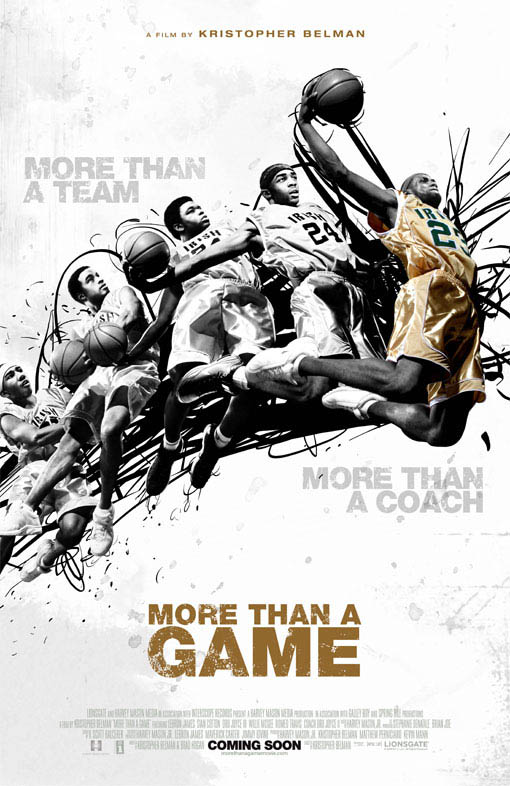
More Than A Game

First runner-up to Slumdog Millionaire for the “Peoples Choice Award” at the 2008 Toronto International Film Festival, More Than A Game is an uplifting tale about friendship, hardship, and determination. The documentary looks at how five friends growing up in Akron, Ohio defied all expectation and changed the way America looked at high school basketball. Through the help of Coach Dru, a businessman who knew little about the sport going in, the five young athletes are forced to overcome many obstacles on and off the court. Not only did four of the five men begin playing together in grade school; but one of them, a kid named LeBron James, would become the first high school student to be handpicked by Sports Illustrated as the next big thing. As the wins start to pile up and the media scrutiny become more rampant, egos arise, relationships become strained, and the adversities mount.

While LeBron James is the marquee name that will most likely bring people to the theatre; the audience will be cheering for Coach Dru and the other members of the aptly dubbed “Fab Five” (Little Dru, Sian, Willie, and Romeo) equally, if not more, by the end. Director Kristopher Belman skillfully gives enough weight to each person so that you get a good understanding of the boys bonds to each other and their coach. Belman could have easily just made a film that was nothing more than a basketball highlight reel. Instead Belman opts to make the basketball games a secondary aspect. The real story is how the boys worked hard to achieve what they wanted. We see the damage the game does to the relationship between Coach Dru and his son Little Dru. Belman also provides good insight to how every choice made by the players drastically changes where they end up later in life. Obviously depending on how much you already know about the LeBron James story may impact how you view the film. For me the film was an eye opener as I knew very little about LeBron prior to his NBA career. Uplifting without being sentimental, More Than A Game is definitely a crowd pleaser on several levels.


Looking for more Big Thoughts From A Small Mind's 2009 Reviews?